
Six simple steps to find a perfume you will actually wear, whether it is your first bottle or your next signature scent.
Jump to a step: Start with what you love · Find your scent style · Choose your strength · Match the occasion · Test on skin · Sample first
How to Choose a Perfume in 6 Steps
Start with scents you already enjoy, then use those preferences to choose a scent style. Consider the concentration and where you plan to wear it. Test on skin, give it time to develop, and try a sample before buying a full bottle. Your own experience matters more than anyone else's favorite.
- Make a short list of scents you already love.
- Choose a fresh, floral, amber or woody starting point.
- Compare concentrations without assuming stronger is always better.
- Think about the setting, season and people around you.
- Test on skin and revisit it throughout the day.
- Try a vial or travel spray before committing.
Step 1: Start With the Scents You Already Love
Use this perfume guide to narrow your choices before browsing bottles. Start with the scents you notice in everyday life. Do you love fresh laundry, lemon peel, morning coffee, a bunch of flowers or wood smoke? Write down three favorites. You are gathering clues, so you do not need to know any perfumery terms yet.
Include perfumes you have enjoyed, even if you have never owned them. If you can, find out the exact name and concentration. A fragrance you remember as light and crisp may have a richer version with a similar name. Knowing which one you liked makes comparisons much easier.
Next, ask what appealed to you. Was it the clean finish, the sweetness or a warm note that lingered? This helps you avoid buying a new bottle simply because it shares one ingredient with an old favorite. Vanilla, for example, can feel sweet and creamy in one composition and dry or woody in another.
Try this: Keep a second, shorter list of anything you prefer to avoid. Together, those two lists help you find the right perfume and give you a useful starting point at a fragrance counter or when reading descriptions online.
Step 2: Find Your Scent Style With a Quick Perfume Scents Guide
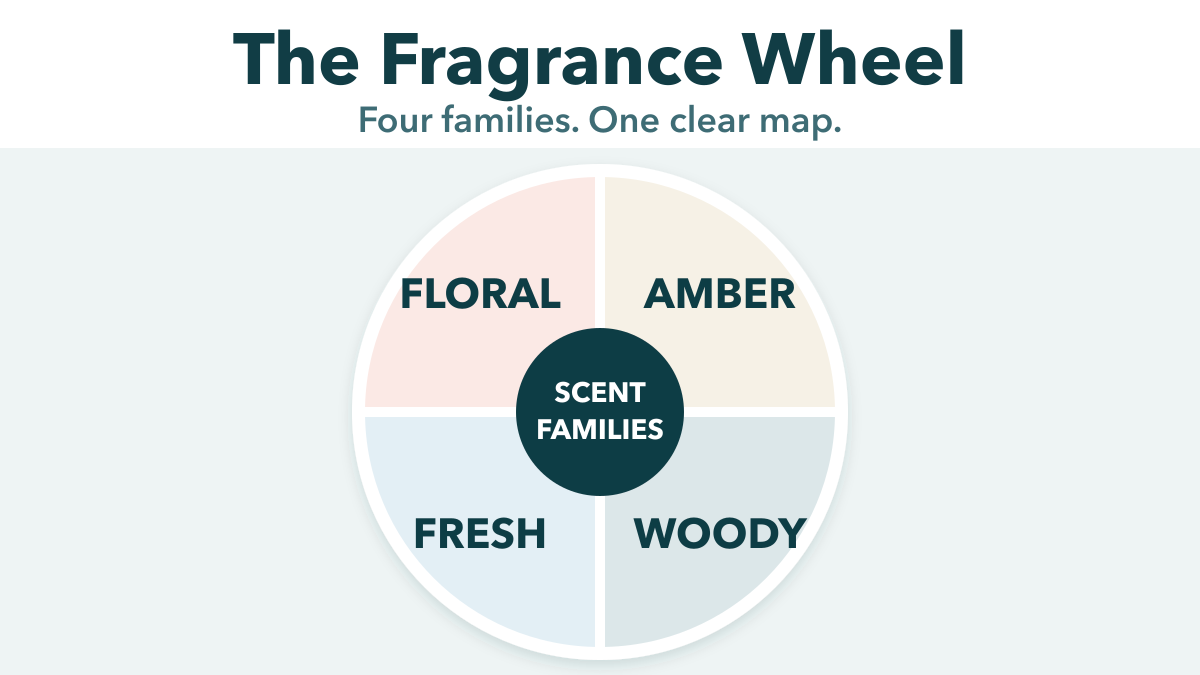
Four broad scent styles can help you narrow the options:
- Fresh: Bright citrus, green or airy notes that can suggest crisp leaves, clean linen or a sea breeze.
- Floral: Compositions built around flower notes such as rose, jasmine, iris or orange blossom.
- Amber: Warm blends that often feature vanilla, resins or spice, ranging from soft to rich.
- Woody: Scents with notes such as cedar, sandalwood or vetiver, which can feel dry, smooth or earthy.
Use this perfume scents guide to get started, without worrying about fitting everything into one box. A fragrance can be both floral and woody, or open with citrus before settling into warm amber notes. Read the full scent description rather than choosing by one familiar note.
Choose one style that feels comfortably familiar and, if you are curious, a second that is slightly different. Someone who likes citrus might try a fresh scent with a woody finish. Someone who enjoys rose could compare a soft floral with a warmer rose-and-amber blend. That gives you a manageable comparison rather than dozens of unrelated options.
Step 3: Choose Your Strength
Eau de toilette often offers a lighter starting point for daytime, though individual formulas vary. Eau de parfum is typically more concentrated and may offer longer wear, making it worth considering for evenings or a fuller scent. Parfum, also called extrait, is generally among the most concentrated formats, but concentration alone does not guarantee intensity or longevity.
You may also see eau de cologne, a label commonly associated with lighter concentrations. In everyday conversation, people use “cologne” more broadly, so check the full product name rather than guessing from that word alone.
A concentration change can also bring a different composition, not simply more of the same scent. If you loved an eau de toilette, try its eau de parfum counterpart before assuming it will feel identical. Our eau de toilette vs. eau de parfum guide explains the differences in more detail.
Step 4: Match the Perfume to When You Will Wear It
Everyday Wear and the Office
For work and everyday errands, a lighter, fresher scent that stays close to the skin is a practical starting point.
Your everyday choice should be comfortable to wear for several hours. During testing, notice whether you still enjoy it while concentrating on something else, rather than only when you deliberately revisit your wrist.
Evenings and Special Occasions
Richer amber and woody scents can suit dinners, dates and formal events. They are useful options when you want warmth or a more noticeable finish, but a floral or fresh fragrance can feel equally right if that is your preference.
Consider the venue as well as the occasion. A small restaurant calls for more restraint than an outdoor gathering. Application matters as much as the name on the bottle.
Warm Weather vs. Cold Weather
Fresh and citrus styles are often appealing in spring and summer. Amber and woody styles can feel especially comfortable in fall and winter. Use those pairings as suggestions, not rules.
Test a fragrance in the conditions where you expect to wear it. A perfume that feels comfortable outdoors on a cool afternoon may seem more noticeable in a warm room. Adjust your application before deciding that an entire scent style is wrong for you.
Step 5: Test It the Right Way
Test on skin, not just paper, because skin chemistry can affect how a fragrance develops and wears. Paper strips are useful for an initial comparison, but they cannot tell you exactly how the perfume will feel during your own day.
Start with no more than two or three fragrances in one session. Label the paper strips so you do not confuse them, then choose the most promising options to try on separate areas of skin. Avoid layering different perfumes in the same spot. Take a break if they begin to blur together.
Give it time: The opening is your first impression. The dry down is the longer-lasting character you notice as the fragrance develops. Revisit it after you have left the counter and again later in the day. You do not need a stopwatch, but you do need more than the first spray.
Make a few notes: what you noticed first, what remained later and whether you wanted to wear it again. Compare your own observations rather than treating someone else's wear-time report as a promise. Body chemistry, application and conditions can all influence the experience.
Step 6: Sample Before You Commit to a Full Bottle
A vial or travel spray usually involves a smaller upfront purchase than a full-size bottle, making it a practical way to try something unfamiliar. It is especially useful online, where you cannot test the fragrance before ordering.
Browse women's vials, men's vials and travel sprays for the options currently available. Check the exact fragrance, concentration, size and packaging before buying. A vial and a travel spray are different formats, and not every fragrance is offered in both.
Check the format: Some travel sprays are independently rebottled by eDiscountPerfumes rather than packaged by the original fragrance house. The listing identifies what you receive. A full-size bottle pictured to identify the scent is not included with a rebottled travel spray.
Wear your sample on more than one occasion if the size allows. Try it during an ordinary day as well as the setting you originally had in mind. A scent can be enjoyable for a few minutes yet less comfortable over an afternoon.
The everyday test: If you keep reaching for it, you have a much better reason to buy the larger bottle. If you do not, the sample has still helped you learn what to look for next. You can refine your preferences without building a shelf of bottles you rarely use.
Boxed, No Box or Tester: Which Format Should You Buy?
For the same fragrance and concentration, boxed, no-box and tester versions contain the same authentic scent. Packaging and price are the main differences. Compare like with like, because a similar product name can refer to a different concentration, size or release.
- New in Sealed Box: Choose this when you want the sealed retail presentation.
- No Box: A new bottle without its retail packaging. Read the listing for the bottle's condition and included items.
- Tester: Produced for retail demonstration, sometimes in plain packaging or without a cap. Testers are new and unused unless the listing specifically states otherwise.
At eDiscountPerfumes, you can review our BBB accreditation information and customer reviews collected through Shopper Approved. Free standard shipping is available to the 48 contiguous states. We are an independent retailer of authentic fragrances.
For more detail on packaging and what to check, read our unboxed fragrances FAQ.
Choosing a Perfume as a Gift
Start with something the recipient already wears. Check the full name and concentration if you can, and notice whether they favor fresh, floral, amber or woody scents. Replacing a known favorite is often a safer decision than selecting something entirely different.
If you are unsure, a familiar, approachable style may be easier to choose than an unusual composition, but there is no scent that everyone loves. A smaller size can reduce the commitment. Avoid choosing only by the bottle's appearance or your own taste.
A sealed-box bottle or gift set gives you a ready-to-wrap presentation. Check a set's listed contents and sizes rather than assuming it includes a full bottle. Our fragrance gift guide offers more ways to narrow the choice, and you can browse women's fragrance gift sets for bundled options.
Common Mistakes When Choosing a Perfume
- Buying on the first spray: Wait for the dry down before deciding whether you enjoy the whole fragrance.
- Testing too many scents at once: Limit yourself to two or three, keep notes and return for another session if needed.
- Blind-buying a full bottle because it is popular: Try a sample first and let your own preferences guide the decision.
- Choosing a strength that does not suit your routine: Compare the specific formulas and test your application in the setting where you will wear it.
Final Thoughts: Your Guide to Perfume in One Line
Know what you like, test on skin and wait for the dry down. Sample before buying a full bottle so you can choose something you genuinely enjoy wearing. Put this perfume guide into practice by exploring our women's, men's and unisex fragrances.
Frequently Asked Questions
How do I choose a perfume for the first time?
Read answer
Start with scents you already enjoy, then compare a few fragrances in a related scent style. Choose a concentration that fits your routine, test on skin and give it time to develop. A vial or travel spray lets you try a fragrance for several occasions before deciding on a full bottle.
Should I test perfume on paper or skin?
Read answer
Use paper to narrow your shortlist, then test the most promising fragrances on skin. Paper helps you compare initial impressions without layering several perfumes on yourself. Skin testing shows how the fragrance wears on you, so revisit it later rather than making your decision at the counter.
What is a signature scent?
Read answer
A signature scent is a fragrance you return to often and associate with your personal style. It does not have to be your only perfume or work for every occasion. Choose one you enjoy beyond the opening spray. Our guide to choosing a signature scent offers a more detailed approach.
Is a tester perfume the same as the retail bottle?
Read answer
A tester contains the same scent as its corresponding retail fragrance. Packaging may differ, and some testers do not include a cap. They are new and unused unless the individual listing says otherwise. Check the concentration and description, and see our unboxed fragrances FAQ for more detail.