
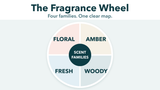
The fragrance wheel is a map for finding the scents you will love.
The fragrance wheel is a circular map that organizes perfume into related scent families. Floral, Amber, Woody and Fresh form its four main sections, while smaller subfamilies connect them. Use the wheel to recognize what you already enjoy, explore nearby styles and find fragrances that fit your mood, occasion and season.
What Is a Fragrance Wheel?
At its simplest, the fragrance wheel is a circular diagram of olfactory families, meaning scent categories built around shared characteristics. Olfactory simply means related to smell. You may also see the tool called a perfume wheel, scent wheel, aroma wheel or fragrance circle.
The wheel makes fragrance language easier to use. If two perfumes you enjoy both sit in the Fresh family, that pattern gives you a practical place to continue exploring. It also shows which directions will feel familiar and which will introduce more contrast.
No wheel can predict taste perfectly. The formula, concentration and the way a scent reacts with your skin still matter. Think of the diagram as a route planner that narrows the options rather than a rulebook that decides what you should wear.
Who Created the Fragrance Wheel? From the Odor Effects Diagram to Michael Edwards
Michael Edwards developed the modern fragrance wheel for consumers and retailers in 1992, building on earlier diagrams that tried to give smell a shared visual language. His version became the best-known tool for comparing families across brands and remains influential in modern perfumery.
- 1949 - Austrian perfumer Paul Jellinek published the Odor Effects Diagram in The Practice of Modern Perfumery. It is widely recognized as the first fragrance wheel.
- 1979 - U. Harder of Haarmann & Reimer developed the Fragrance Circle, another circular system for relating scent categories.
- 1984 - UC Davis sensory chemist Ann C. Noble introduced the wine aroma wheel, applying the same organizing idea to wine aromas.
- 1992 - Michael Edwards created his consumer-friendly Fragrance Wheel to help retailers classify scents and recommend related perfumes.
Following years of industry consultation, Edwards replaced the family name Oriental with Amber. Older fragrance descriptions may still use Oriental, but Amber is now the more common term.
Types of Perfume Scents: The Four Main Fragrance Families
The four main types of perfume scents are Floral, Amber (also called Oriental), Woody and Fresh. Each main scent family covers a broad style, while the smaller groups between them explain why one floral can feel airy and another can feel warm, spicy or deep. In fragrance, a note is an individual smell or scent impression that you can recognize within the full composition.
Floral Scents
Floral scents are built around the impression of flowers, from recognizable rose and jasmine to peony, lily and mixed bouquets. They can feel dewy and transparent, lush and creamy, or polished and powdery depending on the formula.
Soft Floral is the gentler end of this family, where delicate flowers meet musk, powdery notes or aldehydes, aroma materials that can give flowers a sparkling, abstract effect. The overall mood can range from calm and relaxing to expressive and celebratory.
When shopping, look beyond the word floral and check which flower leads the composition. A rose-centered scent may feel velvety or fresh, while jasmine and tuberose can create a creamier, more expansive effect.
Amber (Oriental) Scents
Amber scents are rich, warm compositions that often rely on base notes such as resins, vanilla and spice. Base notes are the slower-fading part of a fragrance. This family was formerly called Oriental, so older descriptions may use that name for the same general area of the wheel.
Common notes include vanilla, cinnamon, musk and patchouli. Amber fragrances often feel enveloping, sensual and well suited to evenings or cool weather, although a lighter floral or citrus opening can make them easy to wear in other settings.
Check the surrounding notes to judge the weight. Soft Amber tends to feel smoother and less dense, while Woody Amber adds a darker, drier frame that can make the same sweetness feel more structured.
Woody Scents
Woody scents use cedarwood, sandalwood and related notes to create a dry, earthy or grounding character. Patchouli and vetiver can add damp earth, smoke, roots, grass or mineral sharpness depending on how they are blended.
The family ranges from smooth, creamy woods to mossy and dry styles with leather or tobacco effects. Woody profiles are useful when you want structure and lasting depth without relying on obvious sweetness.
Sandalwood usually reads smoother than cedarwood, while vetiver can lean earthy, smoky or grassy. That range makes the Woody family broader than the word wood may suggest.
Fresh Scents
Fresh scents are crisp and refreshing. The family includes zesty citrus scents, green notes, water and marine effects, aromatic herbs and fruity scents. Bergamot, lemon, tea, mint and fresh-cut grass are familiar reference points.
Fruity is a subfamily within the Fresh section of this wheel, not a single scent note. Fruit notes can still appear in Floral, Amber or Woody fragrances.
Fresh does not always mean faint or simple. Woods, musk and amber can give a bright opening more staying power, so the finished fragrance may still be long-lasting. Many woody, aromatic and fresh scents are worn by everyone, so browse our unisex fragrances.
Read the base before assuming every Fresh fragrance will stay light. A citrus opening over clean musk feels very different from the same opening over patchouli, leather or dense amber.
Fragrance Wheel Subfamilies: The Scents Between the Families
Subfamilies are the smaller categories that bridge the four main families. They explain why most perfumes do not fit neatly into one box. Moving around the wheel changes the character gradually, so the edge of Floral can begin to pick up Amber warmth while the edge of Fresh can move toward dry woods.
- Soft Floral - delicate flowers, musk and powdery or aldehydic effects.
- Floral Amber - flowers warmed with vanilla, spice or resin.
- Soft Amber - smooth incense, gentle spice and soft resins.
- Woody Amber - amber warmth supported by patchouli, sandalwood or smoky woods.
- Mossy Woods - oakmoss and patchouli effects lifted by amber or citrus.
- Dry Woods - drier woods with leather, tobacco or smoky accents.
- Aromatic (Aromatic Fougère) - a fresh, traditionally lavender-led style with herbs, citrus, woods and sometimes geranium.
- Citrus - bergamot, lemon, orange, mandarin, lime and grapefruit.
- Water (Marine) - watery, salty, mineral or ozonic effects that suggest sea air, rain or clean air before a storm.
- Green - fresh-cut grass, leaves, stems, tea and crisp vegetal notes.
- Fruity - orchard fruit, berries and tropical fruit, often blended with flowers.
These different categories describe the overall impression, not a strict ingredient formula. A fragrance can be classified as Green without containing literal grass, or as Water without using anything taken from the sea.
A List of Scents by Family: Quick Reference
This list of scents gives you the main family, its closest subfamilies, typical notes and the mood those combinations often create.
Each family is built from top, middle and base notes, which shape the opening, main character and lasting dry-down of a fragrance. Our fragrance notes guide explains how those layers develop. Read the family for the overall direction, then check the individual notes to understand how the scent changes over time.
How to Read a Fragrance Wheel: Neighbors and Opposites
Adjacent sections share characteristics and usually blend smoothly. If you already like one family, its neighbors are the easiest next step because they keep part of the profile familiar. Floral Amber bridges flowers and Amber warmth, while Aromatic connects Fresh brightness with the drier edge of the Woody family.
Families across the wheel create stronger contrasts. Perfumers use those opposites to add tension and complexity, such as pairing a crisp Fresh opening with a warm Amber base. Opposite does not mean incompatible. It means the change is more noticeable than a move between neighbors.
If you love fresh citrus, try neighboring Aromatic scents first. Green is another Fresh direction that adds leafy sharpness. When you want more depth, follow Aromatic toward Dry Woods and then broader Woody styles. That route keeps one familiar quality in view while gradually changing the mood.
Find Your Signature Fragrance Scent on the Wheel
Start with smells you already enjoy in daily life, such as fresh-cut grass, vanilla, tea, a favorite candle or cedar from a freshly sharpened pencil. Match that preference to a family, then use the nearby categories to build a focused sample list instead of browsing every fragrance at once.
- Pick the family that best matches a smell you already enjoy.
- Try one neighboring subfamily so the change feels noticeable but not random.
- Sample on skin before buying a full bottle and give the fragrance time to develop.
A paper test strip gives you a first impression of the top notes, or opening, but it cannot show how the full fragrance interacts with your skin. Wear a sample for several hours and check whether the middle and base notes still fit the mood you wanted.
Keep the test focused. Comparing two or three options from the same family teaches you more about your preferences than spraying many unrelated scents at once.
Not sure where to start? Take our fragrance family quiz to find the family that suits you.
By Occasion
Fresh and aromatic profiles often feel easy in the office, during errands or for daytime plans because they tend to read as crisp and open. Floral scents can suit celebrations or social events, while Amber and Woody styles bring warmth and depth to evenings. These are useful starting points, not dress codes.
By Season
Fresh, Green and Citrus styles often feel comfortable in spring and summer. Floral scents also tend to suit warmer months, although richer florals can work in cool weather. Amber and Woody scents usually feel most natural in autumn and winter. These are tendencies, not rules, and any family can work year-round when its weight and application suit the weather.
Travel sprays are a low-risk way to try a new family before buying a full bottle. Test the scent in your normal routine and in more than one kind of weather whenever possible.
Other Ways to Use the Fragrance Wheel
The wheel can guide layering as well as shopping. Scents from neighboring families often complement one another because they share part of their character. Opposite families create a sharper contrast, so layer lightly and test the combination on skin before applying more.
Perfumers and candle makers use the same basic family relationships when building blends. That practical use is why the wheel is more than a retail chart. It helps creators balance familiar notes, introduce contrast and decide how a scent should move from bright to warm, soft to dry, or airy to deep.
Conclusion: Use the Wheel to Find Your Next Favorite Scent
Floral, Amber, Woody and Fresh are the four main families, with subfamilies creating smoother steps between them. Neighbors preserve familiar qualities, while opposites add contrast. Use the fragrance wheel to begin with what you already love and explore one step at a time.
The fragrance family quiz can point you toward a starting family. Once you have a direction, use travel sprays to test that family on skin before committing to a full bottle.