
Eau de Toilette vs. Eau de Parfum: What's the Difference?
Here is the practical difference: eau de parfum usually has more fragrance oil, lasts longer and costs more, while eau de toilette feels lighter and is easier to wear in warm weather. This guide explains what each label means and how to choose the concentration that fits your day, your skin and your budget.
Quick Snapshot: Eau de Toilette vs Parfum
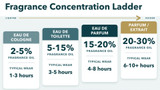
Eau de toilette, or EDT, is the lighter option, with less fragrance oil and a fresher opening. Eau de parfum, or EDP, is usually richer, lasts longer and costs more than EDT, while parfum, also called extrait de parfum, is a separate, more concentrated format.
- Eau de toilette: about 5-15% fragrance oil
- Eau de parfum: about 15-20% fragrance oil
- Parfum or extrait de parfum: about 20-30% fragrance oil
Typical ranges are useful, but they are not universal rules. Brands use the labels differently, and the formula, ingredients, climate and your skin all affect wear.
Shoppers sometimes use "parfum" when referring to eau de parfum. Technically, parfum or extrait de parfum is its own category and usually has a stronger concentration.
Typical planning ranges only. Brand, formula, skin chemistry and climate can change performance.
What Is Eau de Toilette?
Eau de toilette is a lightly concentrated fragrance, usually made with about 5-15% fragrance oil in an alcohol-based formula. The higher proportion of alcohol gives it a quick, bright opening, while the lower oil concentration usually makes it feel airier and fade sooner than eau de parfum.
The eau de toilette meaning comes from the French idea of "grooming water," using an older sense of toilette connected with washing, dressing and personal care. These scented waters were traditionally splashed on after bathing or shaving.
EDT is a strong everyday choice when you want fragrance without a heavy scent cloud. It works well for the office, errands, daytime plans and casual weekends. Many fragrance fans also keep an EDT in rotation for days when they want a fresher take on a familiar scent.
What Is Eau de Parfum?
Eau de parfum usually contains about 15-20% fragrance oil, so it tends to smell fuller and stay noticeable longer than eau de toilette. A typical EDP can wear for roughly 4-8 hours, although the exact result changes with the formula, your skin chemistry, application and the weather.
EDP makes sense when you want a scent to carry through dinner, a date, a wedding or another event without frequent reapplication. It also tends to hold up well in cooler weather, when lighter citrus and aquatic notes can disappear faster. Start with fewer sprays. A higher oil concentration does not mean you need more.
Refreshing Scent: When To Choose Eau de Toilette
Choose eau de toilette when you want a refreshing scent with a bright opening and a lighter drydown. Because an EDT uses less fragrance oil, its top notes often take center stage. Citrus, herbs, aromatics and aquatic accords can feel especially crisp in this format.
That profile suits warm days, crowded rooms and close-range settings. An EDT can give you the lift of bergamot, lemon, lavender or marine notes without carrying the same weight as a richer concentration. It is also a practical option if you enjoy refreshing your fragrance in the afternoon rather than committing to one strong application in the morning.
EDT is not automatically weak. A well-built eau de toilette can project strongly at first, and some outlast softer EDP formulas. Concentration is one clue, not a performance score.
How Eau de Cologne Compares
Eau de cologne is lighter than EDT, usually with about 2-5% fragrance oil. Traditional cologne structures lean citrus-forward, often using bergamot, lemon, orange or neroli for a clean, fast-moving opening.
Reach for eau de cologne on very hot days, after a shower or whenever you want fragrance to stay easy and low-key. It is a good fit for anyone who dislikes a strong scent, with the tradeoff that reapplication is usually part of the deal.
In everyday US conversation, "cologne" often means any fragrance marketed to men, regardless of the concentration printed on the bottle. Check the product title for EDT, EDP, parfum or another concentration before you compare performance or price.
Perfume Oil And Concentration Alternatives
Perfume oil is fragrance carried in an alcohol-free base, usually a neutral carrier oil, instead of the alcohol base used in most sprays. It is commonly sold as a roll-on or dab-on format. Apply a small amount to pulse points and build slowly because the oil sits close to the skin.
An alcohol-free oil may feel less drying for some shoppers, but fragrance ingredients can still irritate sensitive skin or trigger an allergy. Test a small amount first, stop if irritation develops and check the ingredient list. Anyone with a known fragrance allergy should follow a dermatologist's guidance rather than assuming an oil formula is automatically safe.
What Is Parfum (Extrait de Parfum)?
Parfum, also called extrait de parfum, usually contains about 20-30% fragrance oil. It is commonly the most concentrated option in a fragrance line, with long wear, a rich drydown and a higher price per bottle.
Parfum can project less aggressively than a sharp EDT opening while lasting much longer on skin. Think density rather than guaranteed loudness. Compared with eau de parfum, extrait often puts more emphasis on the base and needs fewer sprays or dabs.
Eau de Toilette vs Eau De Parfum: Longevity, Sillage and Price
Eau de parfum generally lasts longer, leaves a more noticeable trail and costs more than eau de toilette. Parfum usually goes further still, but the formula matters as much as the label.
Longevity
An EDT often wears for about 3-5 hours, while an EDP commonly reaches 4-8 hours. These are planning ranges, not promises. A citrus-heavy EDP may fade sooner than a resinous or woody EDT, and two fragrances with the same concentration can perform very differently.
Skin and weather change the result. Dry skin tends to lose fragrance faster, while moisturized skin gives the scent more to cling to. Heat can make the opening bloom quickly and burn off sooner. Cold air can mute projection even when the fragrance remains on skin.
Sillage
Sillage is the trail a fragrance leaves behind. EDT often feels more transparent and sits closer after its bright opening, while EDP often leaves a fuller trail for longer. Projection describes how far the scent radiates at a given moment; sillage describes what follows you as you move.
Neither is determined by oil percentage alone. Ingredient choice, evaporation rate and the balance of top, middle and base notes all matter. A loud EDT can easily out-project a quiet EDP.
Price
EDP usually costs more because the formula uses a higher concentration of aromatic material. Bottle size, release date, packaging and stock also affect the price, so compare the exact listings instead of assuming every price gap comes from concentration.
For the cleanest price comparison, match the bottle size and package condition. The Le Male pair below does that: both products are 4.2 oz. (125 ml.) no-box sprays. It is still a real-world shopping comparison rather than a concentration-only test because Le Male Eau de Toilette and Le Male Le Parfum Eau de Parfum Intense are different interpretations within the same Jean Paul Gaultier line.
The formulas also show why the concentration label cannot make the decision by itself. Jean Paul Gaultier describes the EDT through mint, lavender and vanilla, while Le Parfum opens with cardamom, moves through lavender and iris, and settles into vanilla. Le Male Le Parfum EDP Intense is not simply a stronger version of the original EDT. Shoppers should compare the note profile along with the price and concentration.


Le Male Le Parfum EDP Intense
4.2 oz. / 125 ml. • No box
Cardamom → lavender and iris → vanilla
Use the product links for current prices. These are distinct formulas in the Le Male line, so this is a real shopping comparison—not a concentration-only test.
The EDP premium is easiest to justify when you value longer wear or want fewer touch-ups. If you like reapplying, mostly wear fragrance in warm weather or want the lowest entry price, EDT can deliver better value per use.
Choosing Between Eau De Toilette And Eau De Parfum
Use this rule of thumb: choose EDT for daytime and heat, and EDP for evenings and cooler weather. Then adjust for the actual fragrance, because concentration labels do not erase differences in notes, projection or skin chemistry.
By Occasion
For the office, errands and casual days, EDT is often the easier reach. It gives you presence without asking everyone nearby to share the experience. EDP fits dinners, dates, formal events and long days when you do not want to carry a travel spray.
There is no dress code for concentration. A quiet EDP can work at a desk, and a confident EDT can handle a night out. Sample first and use the number of sprays that fits the room.
By Season
EDT usually shines in spring and summer because its citrus, herbal and aquatic openings feel comfortable in heat. EDP often earns more wear in autumn and winter, when amber, woods, spice, vanilla and musk have room to develop.
Climate matters more than the calendar. If winter where you live still feels warm, shop for the scent profile and performance you actually need.
By Budget
EDT is usually the lower-cost way into a fragrance line. Compare the cost per milliliter, not only the sticker price, and ask whether you will need to reapply. A slightly higher-priced EDP can be better value if two sprays reliably cover your day.
Sampling protects the budget better than guessing. Travel sprays and vials let you test the opening, drydown and wear time before buying a full bottle. At eDiscountPerfumes, we carry many fragrances in both EDT and EDP, including "tester" and "no box" options. Review our unboxed fragrances FAQ to learn how you can save more on the same formulation when you purchase a fragrance without retail packaging.
Eau de toilette
- Daytime
- Warm weather
- Office and errands
- Easy reapplication
Eau de parfum
- Evenings
- Cooler weather
- Dinners and events
- Fewer touch-ups
A practical rule of thumb, not a dress code. Test the actual fragrance on skin.
Sampling And Layering Tips For Eau de Toilette vs Parfum
Test on skin, not only on a paper strip. Paper is useful for narrowing the field, but your skin chemistry and body heat affect the way the fragrance develops. Travel-size sprays are a low-risk way to try a scent before committing to a full bottle. Leave the fragrance alone and wait at least an hour before deciding which drydown you prefer.
For a fair eau de toilette vs parfum test, wear each concentration on a separate day under similar conditions. Note the number of sprays, weather, first-hour projection and the time when you can no longer detect it at arm's length. Do not judge by the first minute; that is where volatile top notes and alcohol are most noticeable.
Moisturized skin can improve longevity. Use an unscented lotion or a matching body lotion or shower gel, then apply fragrance to pulse points. Layering products from the same line builds intensity without mixing unrelated scents. Let the spray dry instead of rubbing your wrists together.
Conclusion: Picking Your Signature Scent
EDT is usually lighter, less expensive and well suited to daytime or warm weather. EDP is generally richer, longer-lasting and more expensive. The best choice is the one that fits your routine and performs well on your skin.
Sample before committing, especially when the EDT and EDP use different note balances. Start with travel sprays and vials, then put your budget toward the bottle you will actually wear.
Ready to compare eau de toilette vs eau de parfum in real life? Browse men's fragrances to compare eau de toilette and eau de parfum versions of the same scent. Shop women's fragrances in both concentrations, and explore unisex fragrances to build a rotation at a better price than the department-store counter.
Frequently Asked Questions